Updated August 28, 2026
PEOPLE · AUTOMOTIVE · MARANELLO
Reading time: 8 minutes
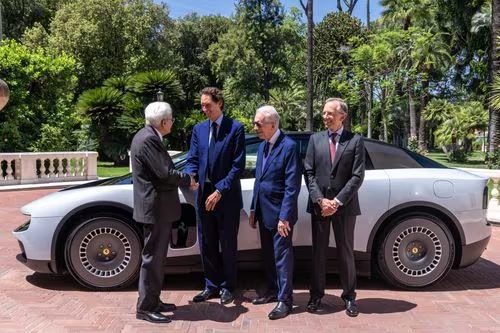
Ferrari’s Luce is more than Maranello’s first fully electric production car. Presented to Italian President Sergio Mattarella in May 2026, it became a stage for a carefully assembled group of people: Ferrari chairman John Elkann, CEO Benedetto Vigna, the company’s engineering teams, and LoveFrom founders Sir Jony Ive and Marc Newson. The story is ultimately about who Ferrari invited into its future—and how deliberately.
Key takeaways
- The Luce was presented to President Sergio Mattarella in an official Ferrari media-centre moment dated 26 May 2026.
- It is Ferrari’s first fully electric production car and its first five-seat model, according to launch coverage from Top Gear and CarExpert.
- LoveFrom, the creative collective founded by Sir Jony Ive and Marc Newson, led the exterior and cabin-interface direction.
- Ferrari says the project generated more than 60 new patents; that figure is also reported by Top Gear and CarExpert.
- The strongest editorial story is not a speculative price or sales figure. It is the collision of Italian institutional symbolism, Maranello engineering and a design language shaped outside Ferrari’s usual studio structure.
There are car launches, and there are moments when a marque chooses to explain itself. Ferrari’s presentation of the new Luce to President Sergio Mattarella belongs to the second category. The car arrived as a technical milestone—Maranello’s first fully electric production model—but the setting and the cast made the event larger than a product reveal. It became a statement about continuity, national identity, creative risk and the kind of people Ferrari wants near its next horizon.
That is why the Luce deserves to be read through its people as much as through its powertrain. The Ferrari Media Centre’s announcement placed Mattarella at the centre of the unveiling. Around the car, the wider story brings together Ferrari chairman John Elkann, CEO Benedetto Vigna, engineers who rethought the architecture of a high-performance EV, and a design partnership with LoveFrom—Sir Jony Ive and Marc Newson’s creative collective.
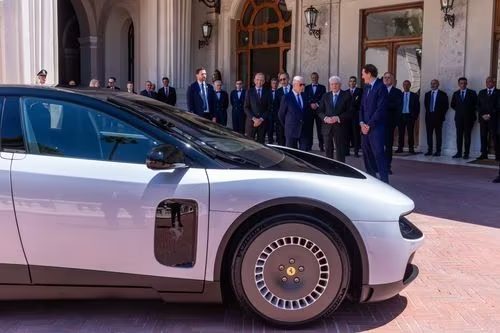
The moment Ferrari chose to show the Luce
Ferrari’s official announcement is concise: the new Luce was unveiled to President Mattarella. That brevity is revealing. An official presidential presentation is not the same thing as a conventional press launch, and it gives the car a civic frame before the conversation reaches horsepower, range or screens.
Independent launch coverage places the wider unveiling in Rome. CarExpert reports that Ferrari selected Rome for the event, connecting the presentation with the location of the marque’s first race victory in 1947, when the 125 S won the Rome Grand Prix. That historical link matters editorially: Ferrari used a formative chapter of its past to introduce the car that opens its fully electric chapter.
Mattarella’s presence also changes the emotional register. The Luce is not presented merely as a new consumer object. It is shown as an Italian industrial and cultural proposition—one that carries the weight of a national icon while asking the public to accept a different shape, a different interface and a different source of propulsion.
The people shaping Maranello’s next chapter
The first character in this story is Ferrari itself: not an abstract badge, but a network of decisions made by its leadership and technical teams. Benedetto Vigna has described the Luce as the result of more than 60 new Ferrari patents and as part of an ecosystem of technology collaborations. The number is significant only because it points to the scale of the rethinking; the company did not simply exchange an engine for a battery and leave the rest of the car untouched.
John Elkann represents another layer of the moment. As Ferrari’s chairman, he stands for the long view: the responsibility of protecting a powerful identity while permitting the company to enter a category that can unsettle its most loyal audience. The Luce is therefore a leadership test. It asks whether a luxury marque can remain recognisable without repeating its own visual and mechanical vocabulary.
Then there are the engineers. Ferrari’s published and reported technical approach centres on a dedicated electric architecture, four motors and a battery integrated into a larger, more spacious vehicle concept. CarExpert reports four electric motors—one for each wheel—alongside a 122 kWh battery and an 800-volt electrical system. It also reports Ferrari’s claimed figures of 772 kW, a 0–100 km/h time of 2.5 seconds and more than 530 km of range. Those are manufacturer claims, not independent test results, and they should be read as such.
Most important, the engineering team used electrification to rethink the brief. Top Gear reports that the Luce is a five-seater and that Ferrari’s vehicle-engineering leadership positioned the larger format as a way to improve packaging, centre of gravity and usability rather than simply recreate a mid-engined supercar with different hardware. That decision helps explain the car’s unusual proportions: the Luce is trying to make electric performance feel native to its architecture.
When LoveFrom entered the Ferrari conversation
The most instantly recognisable names around the Luce may not be Ferrari names at all. LoveFrom, founded by Sir Jony Ive and Marc Newson, led the exterior and cabin-interface direction. This is more than a celebrity-design detail. It changes the creative geometry of the project.
Ferrari has its own celebrated design language and an in-house team led by Flavio Manzoni. Bringing LoveFrom into the conversation creates a deliberate tension between internal heritage and external perspective. Top Gear describes an unusually protected process: Ferrari introduced the project, then allowed the designers to work with extended distance before they returned with books outlining their vision rather than a conventional presentation of renderings.
That process helps explain the Luce’s visual ambition. Ferrari describes a “glass house” and a form shaped by the idea of permeability—air moving through the body rather than simply around it. The language is architectural as much as automotive. The cabin becomes an inhabited volume; the body becomes a frame, a wing and an aerodynamic instrument.
It is also why the design has become part of the public argument around the car. A conventional Ferrari can be understood through familiar signals: a long nose, an aggressive stance, a visible mechanical drama. The Luce asks viewers to recognise a different kind of drama—surface, light, space and interface. Whether one admires it is almost secondary to the fact that it creates a conversation.
The machine behind the symbolism
The Luce still has to work as a Ferrari. Its symbolic setting cannot substitute for a credible driving proposition. The reported specification is therefore useful not as a catalogue, but as evidence of the company’s chosen priorities.
CarExpert reports a four-motor, all-wheel-drive layout with 772 kW and 990 Nm, while Top Gear reports a claimed 1,035 bhp, a 0–62 mph time of 2.5 seconds, a 192 mph top speed and a range of approximately 330 miles. The slight variation between metric and imperial reporting reflects conversion and outlet presentation; the editorial point is consistent: Ferrari wants the Luce to be understood as a serious performance car first, even while it expands the definition of who and what the car can carry.
The car’s interface matters just as much. Samsung Display announced that it supplies four OLED displays exclusively for the Ferrari Luce. That partnership underlines the degree to which the modern luxury automobile is becoming a collaboration between automotive engineering, software, display technology and industrial design. In the Luce, the cabin is not a screen-filled afterthought. It is part of the car’s identity.
Ferrari has also retained a sensory idea of performance. Top Gear reports that the company uses an accelerometer to capture the vibration and texture of the electric motors and gears, then equalises and amplifies the result in the cabin. The aim is not to imitate an internal-combustion soundtrack with a generic recording; it is to make the electric machinery itself perceptible.
Why this is a People story
Cars are often written as if they arrive fully formed. The Luce makes that impossible. Its meaning sits in the network around it: a president receiving the car, a chairman carrying the long-term responsibility, a CEO framing the technological ambition, engineers choosing an architecture that prioritises space, and two external designers challenging the visual grammar of Maranello.
That network is also the reason this launch is useful beyond Ferrari. Every established luxury company now faces a version of the same question: how do you modernise without flattening the identity that made you valuable? Ferrari’s answer is not to pretend that change is invisible. It has made the change visible—through a new name, a new silhouette, a new interior logic and an unusually public group of collaborators.
The Luce may eventually be judged by deliveries, owner experience and long-term reliability. Those are stories for later, and this first note deliberately avoids pretending that launch-day coverage can answer them. What is already clear is the cast and the choice: Ferrari has placed its electric future in a room with Italy’s president, its own leadership and a design studio best known for rethinking the relationship between people and technology.
That is the real unveiling. The Luce is not just a Ferrari with a battery. It is Ferrari asking the world to watch how it changes—and to decide whether the people it chose to make that change are convincing.
Sources and method
Ferrari Media Centre (official announcement; page access returned HTTP 403 in this environment, so it was not treated as a fully readable source). Top Gear (launch and technical reporting). CarExpert (launch and claimed specifications). Samsung Display Newsroom (OLED supplier announcement). All technical figures in this article are identified as manufacturer claims or attributed reporting. Unverified pricing, sales, stock-market reaction and invented quotations were excluded.
FAQ
What is the Ferrari Luce?
The Luce is Ferrari’s first fully electric production car. Launch coverage describes it as a five-seat, four-door model with four electric motors and a dedicated high-voltage architecture.
Who was the Ferrari Luce unveiled to?
Ferrari’s official media-centre announcement says the new Luce was unveiled to Italian President Sergio Mattarella.
Who designed the Ferrari Luce?
LoveFrom, the creative collective founded by Sir Jony Ive and Marc Newson, led the exterior and cabin-interface direction, working alongside Ferrari’s own design and engineering teams.
What is the People angle in this Ferrari story?
The People angle is the group behind the transition: Mattarella as the institutional audience, Ferrari leadership as the custodians of the brand, engineers as the architects of the EV, and LoveFrom as the outside creative perspective.